

Lochwinnoch
The purpose of the site is to help those new to the village to connect with its past and for those who have left for pastures new to remember what was left behind
The West Church (The Free Church)
The West United Free Church was built in 1844 just after the split in the Church of Scotland in 1843 known as the Disruption. The split was over whether a wealthy patron (such as Colonel Harvey who was the owner of Castle Semple at this time) had the right to install a minister of his choosing. The reason for the schism ran deeper than this. The right of patronage fed the main bone of contention that the Church should have spiritual independence. The Church of Scotland was the Established church meaning it was sanctioned by the state. However, the Claim of Rights 1689 brought to an end Royal and Parliamentary interference in the order and worship of the church. The right of patronage was seen to run counter to this. It was enshirned in The Church Patronage (Scotland) Act 1711 which restored this benefit after it was removed in 1690 just after the Glorious Revolution. The arguement for its existance was based on the fact that the main landowner had an obligation to provide a church, burial ground, relief for the poor and provide parish schools. If his nominee was not accepted the Patron was entitled to take back the "donated" property and stipend.
In 1834 the General Assembly passed the Veto Act which gave parishioners the power to reject a minister proposed by their patron. The Court of Session ruled this was Ultra Viris (beyond their power to make such a law). Over the next 10 years matters worsened until in 1843 a cataclysmic event called The Disruption occurred. A substantial number of ministers left the Church of Scotland and set up the Free Church of Scotland. Those who left forfeited livings, manses and pulpits, and had, without the aid of the establishment, to found and finance a national Church from scratch. In 1874 the patronage that fuelled the schism was abolished by an Act of Parliament. However it was not until 1929 that all issues that led to the split were fully removed and the Church re-united that year.
When the Free Church re-joined the Church of Scotland it was decided that one church would go at the first pulpit vacancy. The first minister of the re-united church was Angus Nicolson from 1948 till 1953. The last baptism in the West United Free Church was in 1949.
On Tuesday, the 23rd May 1843, the ‘‘Act of Separation and Deed of Demission” was signed by 474 ministers, who renounced their status, emoluments, and privileges as ministers of the Established Church of Scotland and created the ‘‘Free Protesting Church of Scotland.

On the 4th June 1843, Dr Smith the ‘outed minister” of Lochwinnoch and his adhering flock assembled for public worship in Harvey-square opposite the Parish Church. Nearly a thousand people had assembled. Dr Smith preached facing the church, standing on a chair adjacent to the front door of the house now called Novar. On the following sabbath he positioned himself at the North wall facing the loch. The assembly was even greater.
Their dissenting brethren of the Burgher Church agreed to let them have the use of their meeting house. The hall which had been occupied as the missionary preaching station was also made available.
It was not long before this splintered church found a place to build their own (temporary) wooden church. It was immediately behind what was the Court Hall and was given the nickname “The Spale Kirk”, a spale being a splinter of wood. I think this was a rather derogatory term despite its accuracy of meaning. Even the congregation would not refer to it as a church, instead calling it “the booth”. Unfortunately it was not entirely watertight as well.
A site was found for a new kirk, adjacent to the existing Parish Church. The foundation stone of the new Free Church was laid on Tuesday, 29th August, 1843, by Mr James Love of Knowes. A sermon was given by Rev. Duncan Macfarlan and he took his text from Matthew xvi. 18, “And I say unto thee that thou art Peter, and upon this rock I will build my church, and the gates of hell shall not prevail against her.”
The new church was built in about 8 months but during a storm part of the western wall gave way and had to be rebuilt, delaying completion and adding to the cost. A debt of £800 was incurred and an appeal for funds was undertaken. Some was raised by subscription and in one case a group of previous Lochwinnoch inhabitants bought four pews at 5 shillings each for 4 years to be paid on demand. If this is 5 shillings per week that contribution raised £208. At some point a new manse was built. Today we know it as “West Dene” on Braehead, at one time the home and surgery of Dr Waterson MBE.

The New Free Church was opened on the 14th of April, 1844, by the Rev. Thomas Main, at that time minister of the Free High Church of Kilmarnock. The collection on that first day exceeded expectations and was north of £100.
In 1846, Mr. Smith had the honorary degree of Doctor in Divinity conferred upon him by the Senate of an American University.

In 1859 the Rev. John G. Cunningham, A.M. was unanimously chosen as assistant and successor to Dr. Smith. He was ordained to the charge on the 22nd of December 1859.
Dr. Smith was now in his forty-fifth year as a minister and was the oldest minister in the county. He had kept up regular visits of the whole parish, and was not satisfied if he did not visit and catechise the entire population every second year. On 15th June 1861 Dr Smith had a stroke resulting in paralysis. His last public work in the Church was on the previous Sabbath 9th of June 1861.
The fiftieth year of his ministry started on the 2nd March 1864. This was nearly twenty-one years since the Disruption. He was the last link remaining between the Free Presbytery of Paisley in 1864 and when it was first constituted in 1843. He died on 22nd January aged 78. He had been 28 years in the Established Church and 22 years a minister with the Free Church.
Towards the end of his ministry he noted:- "When I began my ministry I was somewhat sharp and severe in reproving what was wrong; but I have come to think that I am more successful in accomplishing my object by using milder means, and this is far more agreeable to my own feelings."
He was interred in the ‘‘Lochside Lair,” in the Old Kirkyard of Lochwinnoch. Gone before him were three sons who died in infancy, two daughters, Margaret and Marjory who died in their teens and a grandson. He had been born at Grassmilnside, in the parish of Kilmaurs, Ayrshire, 12th of March 1787 and entered Glasgow College in November, 1802. On 28th March 1820 he married Marjory B. Barr, eldest daughter of Captain William B. Barr, of Lochside. They had six sons and five daughters, two of his surviving sons were Robert Barr Smith, Esq., merchant in Adelaide, South Australia, and William Caldwell Smith, M.D.H.E.I.C.S.
The “Lochside Lair” was the inheritance of Mrs. Smith from her forefathers. His monument is a stately obelisk and on the western side of its base is the following inscription:-
IN MEMORY OF THE REV. ROBERT SMITH, D.D., BORN 12th MARCH, 1787, DIED 22nd JANUARY, 1865, IN THE 50th YEAR OF HIS MINISTRY. ORDAINED MINISTER OF THIS PARISH ON THE 2nd OF MARCH, A.D., 1815. AT THE DISRUPTION, IN 1843, HE ABANDONED HIS LIVING, AND WITH A LARGE BODY OFADHERENTS FORMED THE FREE CHURCH CONGREGATION OF LOCHWINNOCH. EVERY ONE THAT HATH FORSAKEN HOUSES, OR BRETHREN, OR SISTERS, OR FATHFR, OR MOTHER, OR WIFE, OR CHILDREN, OR LANDS, FOR MY NAME’S SAKE, SHALL RECEIVE AN HUNDRED FOLD, AND SHALL INHERIT EVER LASTING LIFE. Matt. 19 29.
The Rev. John G. Cunningham was in the sixth year of his ministry when Dr. Smith died. He had done the full work of the cure ever since Dr Smith’s stroke in 1861. Mr. Cunningham's ministry experienced difficult times for his flock. The crisis at the Western Bank in 1857, the cotton crisis in 1861, the fire at the old cotton mill in 1874 greatly diminished attendance at all the churches with many families leaving to find work elsewhere.
When he had been minister for 16 years a call was presented to him from St. Luke’s Free Church congregation in Edinburgh to become successor to the Rev. Moody Stuart, D.D., one of the fathers of the Disruption. Mr. Cunningham saw it to be his duty to accept that call and on 18th of June 1876 he preached his farewell sermon.
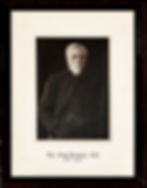
The vacancy that followed lasted about eight months. In the course of that time, fifteen candidates presented themselves for the vacant charge. From that list, a committee appointed by the congregation selected a reduced leet of five, who all preached in the church and three of these appeared to have gained more or less favour with the people. The three popular candidates were the Rev. John Russell, Rev. A. S. M‘Phee, and the Rev. Thomas Collins. All three had their admirers and supporters in the congregation. When the day for the election came, it was found that a majority had voted for the Rev. Mr. Russell, at that time assistant to the Rev. John Laidlaw, Free West Church, Aberdeen. Mr. Russell was therefore declared duly elected, and, having declared his acceptance of the call, was put upon his ‘‘trials” by the Presbytery. On Wednesday 10th of February 1877 Mr. Russell appeared before the Free Presbytery of Paisley, and along with other exercises, delivered his trial discourse. On Thursday the 22nd of February 1877 the Free Presbytery of Paisley met at Lochwinnoch for the ordination of Mr. Russell. He spent his entire ministry of 45 years in Lochwinnoch retiring in 1922. During that time he was Clerk of the Paisley Free Church Presbytery for 38 years. He was also a member of the School Board and Parish Council. He died 23rd November 1934.
He married Jane Dunlop and had six children. Thomas became a railway engineer in India and was appointed Chief Commissioner of Railways, Indian Railway Board in 1929 and was also a member of the Council of State till 1940. He was knighted in 1932 for his services. Jean married, but not her true love who was considered unsuitable. Margaret trained at the Royal Infirmary and served in the Queen Alexandra Imperial Military Service. She was awarded the Royal Red Cross and rose to the rank of Principal Matron. Margaret, Molly and Agnes never married, living together until they died one by one.
Like many churches at this time there was no musical accompaniment during singing. Finally, in 1897 an organ was installed and an organist appointed.

The Rev John Russell was succeeded by the Rev John Blake Russell who was appointed in 1923 as successor to Rev J Russell. From the time of the Union in 1929 the two Church of Scotland churches worked in parallel. There was no apparent open discussion but with a West Church congregation of 370 and a Parish Church congregation of 490 it must have been obvious that this would make a single congregation of a reasonable size. He was minister till 1946 after which the West Church closed its doors as a house of God.
In 1941 during the second world war Rev Russell was appointed to serve for six months with the Church of Scotland Huts and Canteens committee in areas of conflict. He did a second tour of duty and on each occasion Rev. Warner of St John’s (the Parish Church) looked after both churches. Shortly after returning from this second tour he asked to be released to serve as Chaplain to HM Forces for the duration of the war. Rev. Warner was now Clerk to the Presbytery so a locum was found.
In 1946 it was all change. Rev. Warner left St Johns to take up an administrative post with the Maintenance of the Ministry Board of the Church of Scotland. In August 1946 Rev. William Sinclair Stevenson, the senior minister at St John’s died. And in late September Rev. John Blake Russell accepted a call to the Rosemarkie church where he died in 1967 aged 73. The West Church closed its doors as a place of worship in 1947. Before it did and on the last day of his ministry at the West Church Rev John B Russell baptised Anne Sloan. But she was not the last baby baptised in the church. After its "closure", while work was being undertaken in the Parish Church, it was used on a temporary basis and during that time in 1949/50 Tommy Anderson, son of Mrs Anderson, was baptised.
After its closure as a church the old West Church was sold to the County Council for £300 and retained as a Civil Defence store until 1968. A condition of purchase was it should be demolished when no longer required for this purpose. The Council argued it should be retained to be used by light industry to provide employment. A compromise was reached deferring demolition for not more than 5 years.
In the gallery is a photograph of the West Church dated 1970 with a sign for EETO at the entrance. They made insulation products and Pat’s mum worked there for a while. I don’t know when they left and as a company they no longer seem to exist. The gallery also has a drawing by the Clyde Cooperage outlining their plans to demolish the West Church dated 1974.